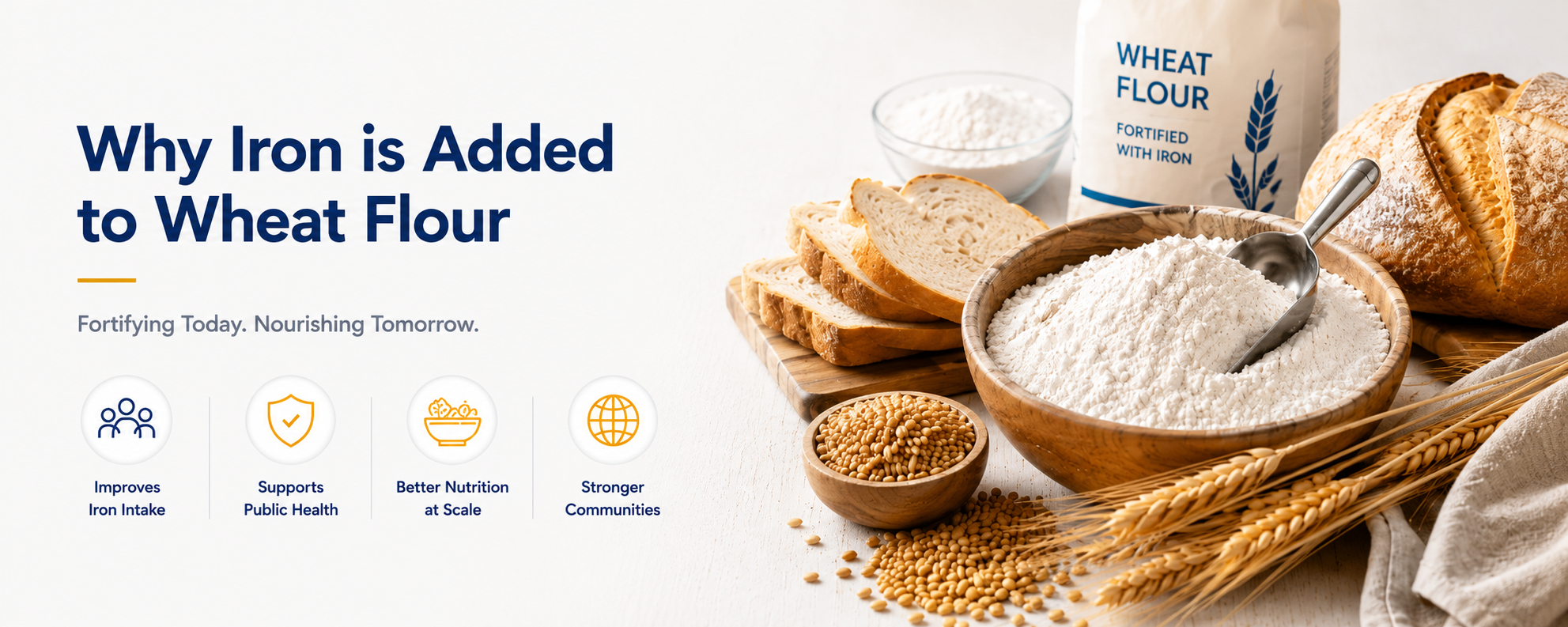
Understanding the Role of Iron Fortification in Staple Food Systems
???? Introduction
Wheat flour is one of the most widely consumed staple food ingredients across many regions of the world. Because flour is used daily in products such as bread, bakery products, noodles, and other staple foods, it is commonly selected as a suitable vehicle for micronutrient fortification programs.
Iron is one of the most frequently added nutrients in wheat flour fortification systems due to the importance of iron nutrition in public health and food enrichment initiatives.
Food fortification programs involving wheat flour are widely used to support improved micronutrient accessibility through regularly consumed foods.
???? Why Wheat Flour is Commonly Used for Fortification
Staple foods are often selected for fortification because they are consumed consistently across large population groups.
Wheat flour is commonly used in fortification programs because it offers:
- Wide daily consumption
- Large population reach
- Consistent distribution systems
- Compatibility with premix systems
- Centralized processing and manufacturing
Because wheat flour is integrated into many everyday food products, it provides an effective platform for delivering micronutrients at scale.
???? Why Iron is Added to Wheat Flour
Iron is added to wheat flour to help support improved dietary iron intake through commonly consumed foods.
Iron fortification is commonly used in:
- Wheat flour
- Bakery flour systems
- Staple food enrichment programs
- Nutritional flour blends
- Public health nutrition initiatives
The goal of flour fortification systems is to support more consistent micronutrient availability through everyday diets.
???? Role of Iron in Fortified Flour Systems
The performance of iron in flour fortification depends on several important technical and formulation considerations.
These may include:
- Bioavailability
- Ingredient purity
- Particle characteristics
- Stability during processing
- Compatibility with flour systems
- Sensory impact considerations
- Storage behavior
Different iron ingredients may behave differently in flour applications depending on manufacturing route, particle size, and surface characteristics.
???? Importance of Bioavailability
Bioavailability refers to how effectively a nutrient can be utilized after consumption.
In food fortification systems, ingredient selection often considers:
- Nutritional performance
- Stability in food systems
- Ingredient compatibility
- Processing behavior
- Long-term formulation consistency
Because different iron ingredients may have different performance characteristics, selecting an appropriate iron source is an important part of fortified flour formulation.
???? Stability in Wheat Flour Fortification
Fortified flour systems require ingredients that remain stable during:
- Flour processing
- Transportation
- Packaging
- Storage
- Food preparation conditions
Ingredient stability helps support:
- Consistent nutrient distribution
- Reliable product quality
- Controlled sensory behavior
- Long-term formulation performance
For this reason, controlled manufacturing and ingredient consistency are important in food-grade iron powders used for flour fortification.
???? Sensory Considerations in Flour Fortification
Sensory performance is an important consideration in fortified food systems.
Iron ingredients used in wheat flour fortification are often evaluated for their influence on:
- Taste
- Color
- Texture
- Product appearance
- Processing compatibility
Food-grade iron powders designed for fortification applications are often selected to help minimize sensory impact while supporting nutritional objectives.
???? Role of Premix Systems
In many fortification programs, iron ingredients are incorporated into vitamin and mineral premix systems before addition into flour processing operations.
Premix systems help support:
- Consistent nutrient distribution
- Controlled dosing
- Manufacturing efficiency
- Improved formulation management
Ingredient compatibility and stability are important considerations within premix manufacturing systems.
???? Global Wheat Flour Fortification Programs
Many countries support wheat flour fortification initiatives as part of broader public health and nutrition programs.
These systems commonly involve:
- Flour mills
- Premix manufacturers
- Ingredient suppliers
- Regulatory organizations
- Food manufacturers
- Nutrition-focused public health programs
Large-scale fortification systems require consistent ingredient quality and controlled manufacturing standards to support reliable performance.
???? Serena Nutrition Perspective
At Serena Nutrition, we manufacture high-purity iron powders designed for food fortification and nutritional applications.
Our approach emphasizes:
- Food-grade manufacturing systems
- Stable particle characteristics
- Controlled manufacturing processes
- Consistent product quality
- Technical reliability for fortified food applications
We believe ingredient consistency, stability, and process discipline are important foundations of dependable flour fortification systems.
???? Key Takeaways
- Wheat flour is widely used as a staple food fortification vehicle
- Iron is commonly added to flour to support improved nutritional intake
- Ingredient selection influences bioavailability and formulation performance
- Stability and sensory behavior are important in fortified flour systems
- Premix compatibility and consistency are important technical considerations
- Global flour fortification programs support public health nutrition initiatives
- Controlled manufacturing helps support reliable fortified food performance