Understanding the Importance of Manufacturing, Refinement, and Process Control
???? Introduction
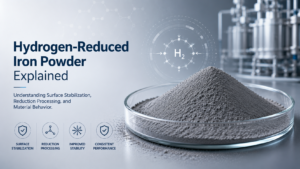
Iron powder quality is often misunderstood when evaluation is based only on visual appearance.
Two iron powders may appear similar in:
- Color
- Texture
- Particle appearance
- Flow characteristics
yet behave very differently during storage, processing, blending, and application.
This is because iron powder performance depends far more on manufacturing route, refinement quality, impurity control, and surface characteristics than on appearance alone.
???? Why Visual Appearance Can Be Misleading
Iron powder appearance provides only limited information about the actual characteristics of the material.
Visual similarity does not necessarily indicate similarity in:
- Purity
- Surface condition
- Oxygen-related characteristics
- Stability
- Manufacturing consistency
- Long-term reliability
Performance differences often originate from internal material characteristics not visible to the eye.
???? Manufacturing Route Matters
The manufacturing process strongly influences iron powder behavior.
Different manufacturing routes may create differences in:
- Surface structure
- Impurity profile
- Particle characteristics
- Oxidation behavior
- Storage stability
Controlled manufacturing systems help establish more stable and reproducible material properties.
???? Refinement Quality and Material Behavior
Refinement depth plays a major role in determining material consistency and reliability.
Controlled refinement helps support:
- High iron purity
- Stable impurity profile
- Reduced variability
- Consistent surface systems
- Predictable processing behavior
The refinement process often influences performance more significantly than visual appearance.
???? Surface Characteristics Influence Performance
The surface condition of iron powder particles strongly affects material behavior.
Surface characteristics may influence:
- Oxidation tendency
- Storage stability
- Moisture interaction
- Reactivity
- Processing consistency
These characteristics are determined by manufacturing and downstream processing rather than appearance alone.
???? Oxygen-Related Characteristics
Iron powders with similar appearance may still differ significantly in oxygen-related surface behavior.
Differences in oxygen characteristics may influence:
- Stability during storage
- Surface oxidation behavior
- Long-term consistency
- Environmental interaction
Controlled surface stabilization systems help support more predictable material performance.
???? Particle Size and Structural Differences
Powders that visually appear similar may still have different:
- Particle size distribution
- Surface area characteristics
- Particle morphology
- Structural consistency
These differences can influence blending, flow behavior, storage stability, and processing performance.
???? Importance of Batch Consistency
Reliable material performance depends heavily on manufacturing reproducibility.
Consistency-focused production systems help maintain:
- Stable impurity profile
- Controlled surface characteristics
- Uniform particle systems
- Predictable material behavior
Batch consistency cannot be determined accurately through appearance alone.
???? Why Technical Evaluation Matters
Proper iron powder evaluation typically involves technical assessment of:
- Manufacturing route
- Refinement method
- Impurity control
- Surface stability
- Particle characteristics
- Storage behavior
- Process reproducibility
Controlled technical evaluation provides a more accurate understanding of material quality and suitability.
???? Serena Nutrition Perspective
At Serena Nutrition, iron powder quality is approached through controlled manufacturing, refinement-focused processing, and consistency-driven production systems.
Our approach emphasizes:
- Purification-focused manufacturing
- Controlled surface systems
- Stable particle characteristics
- Reproducible batch quality
- Long-term material reliability
We believe iron powder performance should be evaluated based on controlled manufacturing and material behavior — not visual appearance alone.
???? Key Takeaways
- Visual appearance alone does not define iron powder quality
- Manufacturing route strongly influences performance
- Refinement quality affects purity and consistency
- Surface characteristics impact stability and reactivity
- Particle systems influence flow and processing behavior
- Batch consistency is critical for reliable performance
- Technical evaluation is more important than visual comparison