Understanding Why Controlled Manufacturing Systems Matter for Reliable Material Performance
???? Introduction
Process consistency is one of the most important foundations of reliable iron powder manufacturing.
Consistent manufacturing systems help ensure that iron powder maintains stable and reproducible characteristics across production batches, storage conditions, and application environments.
Controlled process systems may influence:
- Surface stability
- Impurity profile
- Particle characteristics
- Oxidation behavior
- Batch reproducibility
- Long-term material reliability
For this reason, process consistency is a critical factor in evaluating iron powder quality and performance.
???? What is Process Consistency?
Process consistency refers to the ability to maintain stable manufacturing conditions and reproducible material characteristics throughout production.
Consistency-focused manufacturing helps support:
- Uniform material behavior
- Controlled surface systems
- Stable impurity characteristics
- Predictable processing performance
Reliable manufacturing systems depend on controlled process discipline rather than isolated inspection alone.
???? Why Process Consistency Matters
Variability during manufacturing may influence:
- Surface oxidation behavior
- Material stability
- Particle distribution
- Flow characteristics
- Long-term reproducibility
Controlled process systems help reduce variability and support predictable material performance across applications.
???? Manufacturing Parameters and Stability
Iron powder behavior is strongly influenced by controlled manufacturing parameters.
Important factors may include:
- Refinement conditions
- Thermal processing control
- Reduction environment
- Pulverization systems
- Classification processes
- Surface stabilization conditions
Stable process control helps establish more reproducible powder characteristics.
???? Influence on Surface Characteristics
Surface condition depends heavily on manufacturing consistency.
Controlled processing helps support:
- Stable oxidation behavior
- Uniform surface systems
- Reduced variability during storage
- Predictable environmental interaction
Surface consistency is important for long-term material reliability.
???? Influence on Impurity Profile
Process consistency also influences impurity management.
Stable manufacturing systems help maintain:
- Controlled impurity profile
- Reduced contamination variability
- Reproducible purification characteristics
- Stable batch quality
Impurity consistency is particularly important in technically sensitive applications.
???? Particle Characteristics and Reproducibility
Consistent manufacturing systems help maintain stable:
- Particle size distribution
- Powder flow characteristics
- Surface area behavior
- Structural consistency
Controlled particle systems support predictable handling and processing behavior.
???? Role of Process Monitoring
Modern manufacturing systems often include controlled monitoring of:
- Production conditions
- Thermal parameters
- Environmental exposure
- Surface stabilization stages
- Batch traceability systems
Monitoring helps maintain reproducibility and manufacturing reliability.
???? Batch-to-Batch Reliability
Reliable production systems help support:
- Consistent material performance
- Stable surface characteristics
- Predictable storage behavior
- Uniform processing performance
Batch reproducibility is one of the key indicators of controlled manufacturing quality.
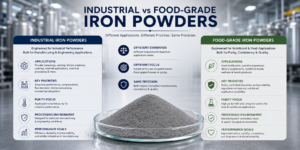
???? Why Appearance Alone is Misleading
Iron powders may appear visually similar while differing significantly in process consistency and reproducibility.
Differences in process control may influence:
- Stability
- Surface behavior
- Storage consistency
- Long-term reliability
- Application performance
Manufacturing discipline influences performance more than appearance alone.
???? Serena Nutrition Perspective
At Serena Nutrition, process consistency is approached through controlled manufacturing systems, refinement-focused production, and stability-driven process discipline.
Our approach emphasizes:
- Controlled manufacturing parameters
- Stable surface systems
- Reproducible impurity control
- Batch-to-batch consistency
- Long-term material reliability
We believe process consistency is essential for dependable and predictable iron powder performance.
???? Key Takeaways
- Process consistency strongly influences iron powder behavior
- Controlled manufacturing reduces variability
- Stable process systems support reproducible material characteristics
- Surface consistency depends on manufacturing discipline
- Impurity management requires stable process control
- Batch reproducibility is essential for reliable performance
- Appearance alone does not define manufacturing quality or consistency