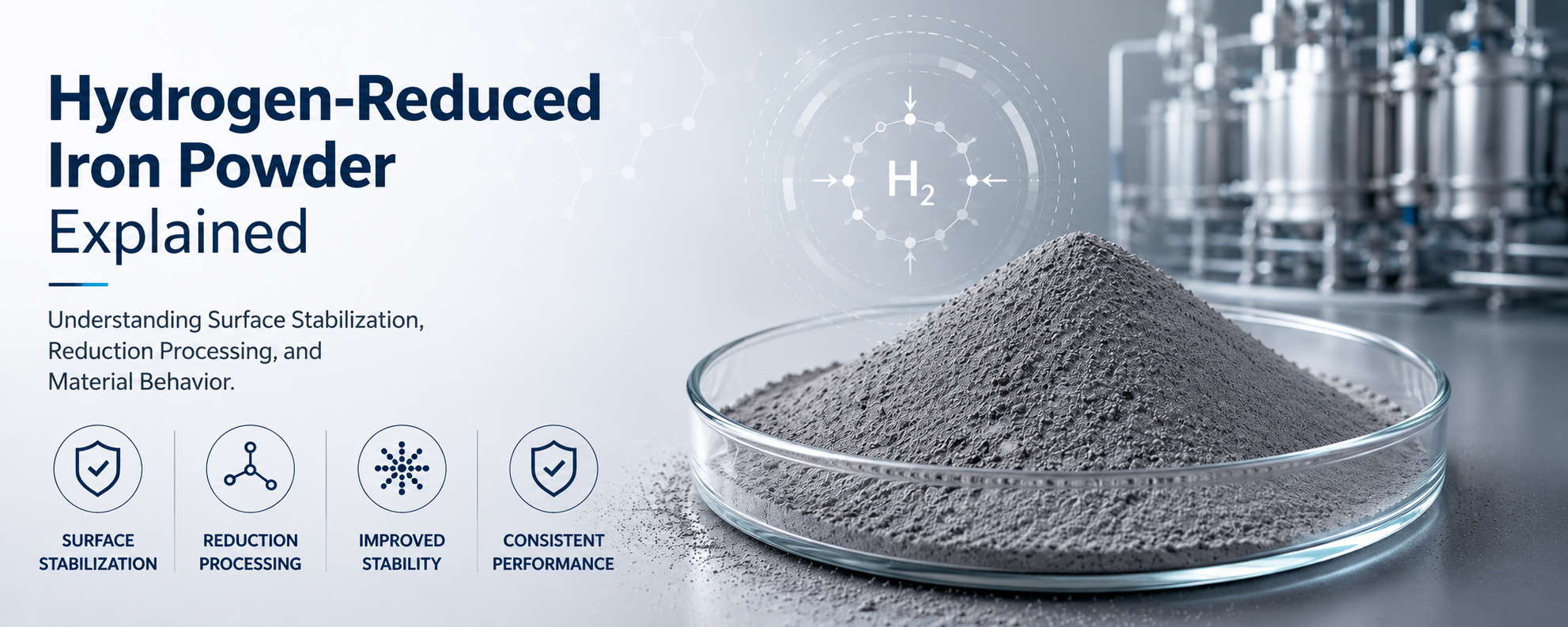
Understanding How Particle Characteristics Affect Stability, Processing, and Material Behavior
???? Introduction
Particle size is one of the fundamental characteristics influencing the behavior and performance of iron powder across technical, nutritional, chemical, and industrial applications.
Differences in particle size can affect:
- Surface area
- Flow behavior
- Blending consistency
- Reactivity
- Stability
- Processing performance
For this reason, particle size control is an important part of consistent iron powder manufacturing.
???? What is Particle Size?
Particle size refers to the dimensions of individual iron powder particles.
Iron powder systems typically contain a distribution of particle sizes rather than a single uniform size.
Particle characteristics may include:
- Fine particles
- Medium particle fractions
- Coarser particle fractions
- Particle size distribution range
The manufacturing route and downstream processing strongly influence these characteristics.
???? Why Particle Size Matters
Particle size influences how iron powder behaves during handling, storage, blending, and processing.
Changes in particle size may affect:
- Surface interaction
- Material flow
- Packing behavior
- Oxidation tendency
- Reactivity
Controlled particle size distribution helps support more predictable and reproducible material performance.
???? Surface Area and Reactivity
Finer particles generally have higher surface area relative to their volume.
Higher surface area may influence:
- Surface reactivity
- Oxidation behavior
- Interaction with surrounding materials
- Stability during storage
Particle size therefore plays an important role in balancing reactivity and stability characteristics.
???? Particle Size and Flow Behavior
Particle characteristics can strongly influence powder flow properties.
Flow behavior may affect:
- Blending consistency
- Feeding systems
- Material handling
- Process uniformity
Controlled particle distribution helps support smoother and more consistent processing behavior.
???? Influence on Blending and Uniformity
In formulation and premix systems, particle size distribution can influence:
- Uniform mixing
- Segregation tendency
- Distribution consistency
- Processing reproducibility
Controlled particle systems help improve consistency across production batches and formulation environments.
???? Particle Size and Stability
Particle size may also influence long-term material behavior, including:
- Surface oxidation
- Moisture interaction
- Storage consistency
- Agglomeration tendency
Stable and controlled particle systems help support predictable storage performance.
???? Manufacturing Route and Particle Characteristics
Particle characteristics are influenced by:
- Refinement process
- Pulverization methods
- Classification systems
- Thermal processing
- Downstream stabilization steps
Controlled manufacturing helps establish more reproducible particle distributions and stable powder behavior.
???? Why Appearance Alone is Misleading
Two iron powders may appear visually similar while having significantly different particle size distributions.
Differences in particle characteristics may influence:
- Flow behavior
- Stability
- Surface reactivity
- Processing consistency
- Material performance
Particle behavior is determined through controlled manufacturing and classification processes, not visual appearance alone.
???? Serena Nutrition Perspective
At Serena Nutrition, particle size control is approached as part of an integrated manufacturing philosophy focused on consistency, stability, and process reliability.
Our approach emphasizes:
- Controlled downstream processing
- Stable particle distribution
- Consistent manufacturing conditions
- Reproducible powder characteristics
- Batch-to-batch reliability
We believe controlled particle characteristics are essential for predictable and reliable iron powder performance.
???? Key Takeaways
- Particle size strongly influences iron powder behavior
- Surface area affects reactivity and stability
- Controlled particle distribution supports processing consistency
- Flow behavior is influenced by particle characteristics
- Manufacturing route impacts final particle structure
- Stable particle systems contribute to long-term reliability