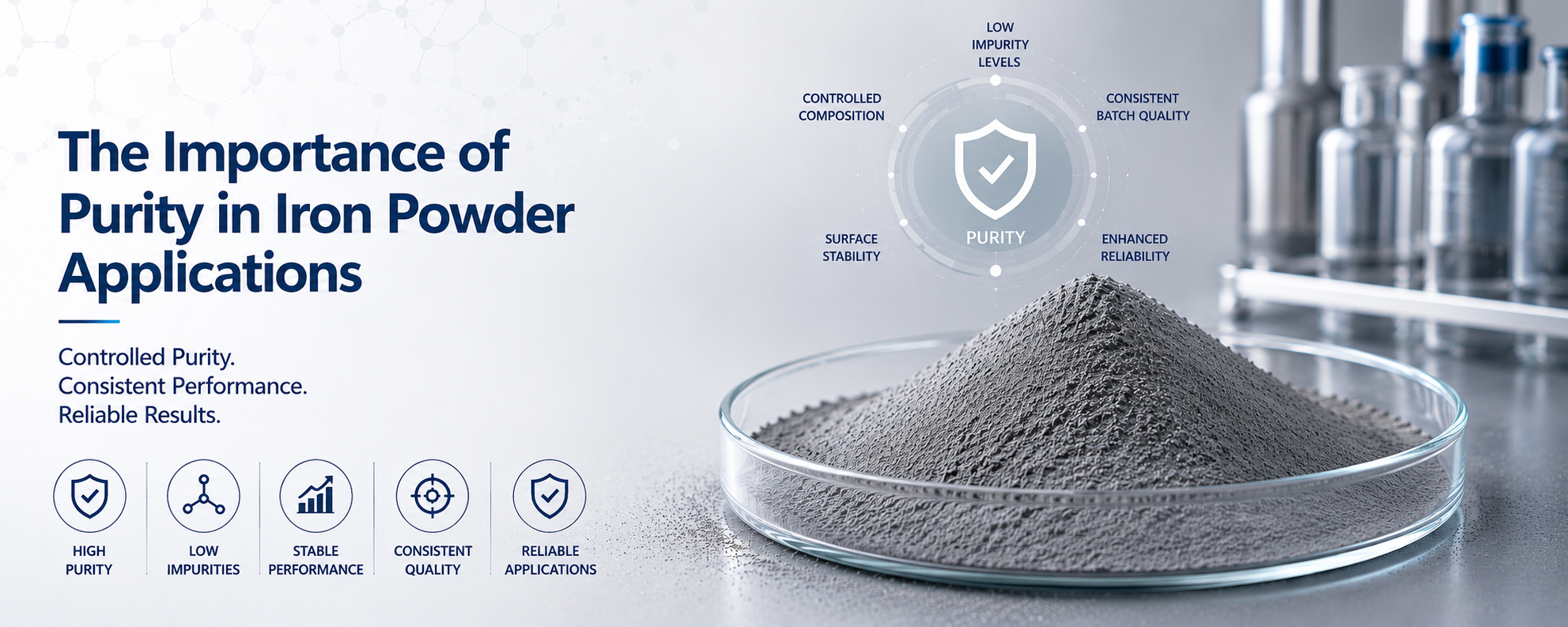
Understanding Why Controlled Purity Influences Material Performance
???? Introduction
Purity is one of the most important characteristics influencing the behavior and reliability of iron powder across technical, nutritional, chemical, and industrial applications.
While iron content is commonly referenced, material performance is influenced not only by total iron percentage, but also by:
- Impurity profile
- Surface condition
- Stability characteristics
- Consistency across batches
Controlled purity helps support predictable processing behavior, stable performance, and long-term reliability.
???? What Does Purity Mean in Iron Powder?
Purity generally refers to the proportion of iron relative to other elements or residual materials present within the powder.
These may include:
- Metallic impurities
- Non-metallic impurities
- Oxide-related compounds
- Residual insoluble materials
- Trace elements
The type, level, and distribution of impurities can influence how iron powder behaves in different systems and processes.
???? Why Purity is Important
In many applications, even small variations in impurity profile can influence:
- Material consistency
- Stability during storage
- Surface behavior
- Reactivity
- Processing performance
Controlled purity helps reduce variability and supports more reliable material behavior.
???? Purity and Process Stability
Manufacturing processes often depend on stable and predictable raw material characteristics.
Variations in purity may influence:
- Blending behavior
- Formulation stability
- Chemical reaction consistency
- Surface oxidation tendencies
- Long-term storage performance
Controlled impurity management supports improved process reproducibility across production batches.
???? Surface Characteristics and Purity
Surface condition is closely related to manufacturing route and impurity control.
Impurities present at or near the particle surface may affect:
- Oxidation behavior
- Surface reactivity
- Interaction with surrounding materials
- Stability under storage conditions
Higher refinement and controlled processing help support more uniform surface characteristics.
???? Purity Beyond Iron Percentage
High iron percentage alone does not fully define material quality or performance.
Two iron powders with similar iron content may still behave differently due to differences in:
- Refinement depth
- Residual impurities
- Oxygen-related characteristics
- Surface condition
- Manufacturing consistency
For this reason, purity evaluation often involves broader assessment beyond elemental iron percentage alone.
???? Purity and Batch Consistency
Consistency in impurity profile is often as important as purity itself.
Variability between batches can affect:
- Material performance
- Stability
- Processing behavior
- Product reproducibility
Controlled manufacturing systems help support more stable impurity management and improved batch-to-batch consistency.
???? Importance in Technical Applications
Controlled purity is important across multiple industries and process environments.
Applications often requiring tighter impurity control include:
Food & Nutrition
- Food fortification systems
- Nutritional premixes
- Dietary supplements
Chemical & Industrial Processes
- Specialty chemical synthesis
- Surface-sensitive reactions
- Controlled industrial systems
Application suitability depends on process conditions, technical requirements, and performance expectations.
???? Why Manufacturing Route Matters
Purity is strongly influenced by manufacturing route and refinement approach.
Manufacturing systems emphasizing controlled refinement and impurity management help support:
- Stable chemistry
- Reduced variability
- Consistent surface behavior
- Long-term material reliability
The manufacturing process itself plays a major role in determining final material quality.
???? Serena Nutrition Perspective
At Serena Nutrition, purity is approached as part of an integrated manufacturing philosophy focused on refinement, process control, and consistency.
Our manufacturing approach emphasizes:
- Controlled refinement processes
- Stable impurity profiles
- Consistent manufacturing conditions
- Batch-to-batch reliability
- Long-term material performance
We believe purity should be evaluated not only by iron percentage, but by the overall consistency and control of the material system.
???? Key Takeaways
- Purity influences material behavior and long-term reliability
- Impurity profile can affect stability, reactivity, and consistency
- Surface characteristics are closely linked to purity control
- High iron percentage alone does not fully define performance
- Manufacturing route strongly influences final purity characteristics
- Controlled refinement supports stable and predictable material behavior