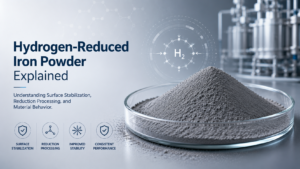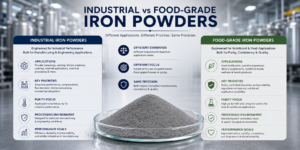
Understanding Manufacturing Purity, Process Engineering & Industrial Material Consistency
???? Introduction
Industrial iron powders can be manufactured through different production routes depending on:
- Application requirements
- Manufacturing priorities
- Material engineering goals
- Industrial processing needs
Different manufacturing systems may produce iron powders with significantly different:
- Purity profiles
- Particle characteristics
- Surface stability
- Thermal behavior
- Manufacturing consistency
Among industrial manufacturing approaches, controlled refinement systems and conventional ore-based reduction methods represent two fundamentally different production philosophies.
These systems differ not only in manufacturing approach, but also in:
- Process control
- Material consistency
- Surface engineering
- Impurity management
- Industrial reproducibility
As industrial technologies continue advancing, many applications increasingly emphasize controlled manufacturing systems capable of supporting stable and predictable material performance.
???? Understanding Controlled Refinement Systems
Controlled refinement systems are manufacturing approaches focused on:
- Purification
- Process stability
- Controlled material engineering
- Stable manufacturing reproducibility
These systems often emphasize:
- Controlled impurity management
- Stable particle characteristics
- Reliable surface consistency
- Precision manufacturing environments
Refinement-focused systems may involve:
- Electrochemical purification methods
- Controlled thermal stabilization
- Precision classification systems
- Process-oriented manufacturing technologies
The goal is often to support:
- Stable industrial performance
- Reduced variability
- Reliable long-term reproducibility
???? Understanding Conventional Ore-Based Reduction
Conventional ore-based reduction systems generally involve:
- Mineral reduction processes
- Large-scale industrial extraction systems
- Thermal ore conversion methods
- High-volume production environments
These systems are widely used in many industrial applications because they support:
- Large-scale production
- Industrial scalability
- Broad manufacturing integration
Different ore-based systems may produce different:
- Particle structures
- Surface characteristics
- Purity profiles
- Thermal behaviors
Application suitability therefore depends heavily on industrial requirements and processing expectations.
???? Differences in Manufacturing Philosophy
Controlled refinement systems often emphasize:
- Manufacturing precision
- Stable process environments
- Controlled particle engineering
- Reliable industrial reproducibility
Conventional ore-based systems may prioritize:
- Large-scale manufacturing efficiency
- Industrial volume production
- Broad application flexibility
Different industrial applications may therefore require different balances between:
- Precision engineering
- Manufacturing economics
- Process stability
- Material consistency
???? Impurity Management and Material Consistency
Controlled refinement systems generally place stronger emphasis on:
- Stable impurity profiles
- Controlled surface consistency
- Reliable process reproducibility
- Reduced material variability
Impurity characteristics may influence:
- Thermal behavior
- Surface interaction
- Oxidation tendency
- Long-term industrial reliability
Controlled manufacturing environments help support:
- Stable industrial integration
- Reliable material performance
- Consistent processing behavior
???? Surface Stability and Oxidation Behavior
Surface condition strongly influences:
- Environmental interaction
- Thermal processing behavior
- Long-term storage consistency
- Industrial reproducibility
Controlled refinement systems often emphasize:
- Surface stabilization
- Controlled oxidation management
- Reliable environmental consistency
Stable surface systems help support:
- Reduced variability
- Reliable thermal integration
- Improved manufacturing reproducibility
???? Particle Engineering and Industrial Performance
Particle characteristics may differ depending on:
- Manufacturing route
- Refinement systems
- Thermal processing methods
- Classification technologies
Controlled particle systems help support:
- Reliable compaction behavior
- Stable flow characteristics
- Improved thermal integration
- Predictable industrial processing
Precision particle engineering therefore becomes increasingly important in advanced industrial applications.
???? Manufacturing Consistency and Long-Term Reliability
Industrial systems increasingly require:
- Stable process environments
- Reliable manufacturing reproducibility
- Controlled material engineering
- Long-term industrial consistency
Controlled refinement systems help support:
- Reduced variability
- Stable industrial integration
- Reliable process performance
- Consistent manufacturing quality
Manufacturing discipline therefore remains an important part of advanced industrial material engineering.
???? Evolving Industrial Requirements
Modern industrial applications increasingly emphasize:
- Precision particle engineering
- Controlled impurity management
- Surface stabilization
- Reliable manufacturing reproducibility
- Long-term process consistency
As industrial systems continue advancing, demand is expected to increase for:
- Stable engineered powder systems
- Controlled manufacturing quality
- Reliable industrial integration
- Precision manufacturing technologies
???? Serena Nutrition Perspective
At Serena Nutrition, we manufacture high-purity iron powders through controlled manufacturing systems designed for specialty and industrial applications.
Our approach emphasizes:
- Controlled impurity management
- Stable particle characteristics
- Reliable surface consistency
- Manufacturing reproducibility
- Process-oriented quality systems
- Long-term industrial reliability
We believe controlled refinement systems and manufacturing precision are important foundations of dependable industrial iron powder technologies.
???? Key Takeaways
- Industrial iron powders may be produced through different manufacturing systems
- Controlled refinement and ore-based reduction represent different manufacturing approaches
- Refinement-focused systems emphasize precision, stability, and reproducibility
- Surface stability and impurity management strongly influence industrial performance
- Particle engineering affects thermal behavior and process consistency
- Controlled manufacturing systems support dependable industrial reproducibility
- Advanced industrial applications increasingly depend on precision-engineered powder